Showing posts with label Church. Show all posts

Tuesday, September 3, 2013

Choose Life


This article is being posted in light of the Torah portion that was read this Shabbat that has just past (Nitzavim).

There is a very large and popular church in the city where I live (Pretoria South Africa) which has the name of “Choose Life Church.” Now, we all have to assume that this church was named after a passage from the Bible, as it is a Christian church. In fact, on their website, they admit that this is true. Now, if this is the case, then this church must stand up to the principles taught in the Bible too, or at least in the verse from which it gets its name from. If you do a little research, then you will quickly realize that the term, “choose life” appears only once in the entire Scriptures. It is not found in the “New Testament” but actually only in the Torah.

The verse that this particular church used in reference to their name is Deut 30:19. Let us read it together:

”I call heaven and earth to record this day against you, that I have set before you life and death, blessing and cursing: therefore choose life, that both thou and thy seed may live” (Deut 30:19 KJV)

It is actually a very nice name that is based on a very lovely and beautiful verse in the Scriptures. The Almighty has set before us life and death and has given us the choice as to which one we want to choose. The church in question (Choose Life Church) has clearly stated which one they claim to have chosen, and which things that they supposedly teach accordingly.

The Scriptures make it very clear what choosing life entails and what we need to do in order to choose this life. It clearly says that the Almighty has set it before us and that the heaven and the earth are witnesses to this. We need to read the entire chapter in order to know what choosing life is all about, according to the Word of the Almighty. For a restriction of space, let us start reading from vs 15:

“See, I have set before you today life and good, and death and evil, in that I am commanding you today to love יהוה (YHWH) your Elohim, to walk in His ways, and to guard His commands, and His laws, and His right-rulings. And you shall live and increase, and יהוה (YHWH) your Elohim shall bless you in the land which you go to possess” (Deut 30:15-16).

In the verses above is the formula for choosing life. Choosing life is to love the Almighty, to walk in His ways, and to guard (do) His commands, His Laws, and His right rulings. If you do this, then you are choosing life. This is saying that we need to do all that is written in the Torah.

But what happens when you do not do these things? Well, let us read further to see.

“But if your heart turns away, and you do not obey, and shall be drawn away, and shall bow down to other mighty ones and serve them, I have declared to you today that you shall certainly perish, you shall not prolong your days in the land which you are passing over the Yardĕn to enter and possess” (Deut 30:17-18)

The disobedience of the Torah is to turn away your heart from the Almighty. If this happens then you will bow down to other mighty ones and serve them. When this happens, the verse says, “you shall certainly perish”. The disobedience of the Torah is choosing death.

So with this information from the Scriptures, it is safe to assume that any institution who claims to base their faith on the Scriptures and who call themselves by the title of, “Choose Life” should in fact be following and teaching the Torah, just as the Messiah did. If not, then they are liars and teach only lies. “And by this we know that we know Him, if we guard His commands. The one who says, “I know Him,” and does not guard His commands, is a liar, and the truth is not in him” (1 John 2:3-4). One cannot take a title or verse from the Scriptures and use it totally in the wrong context. If one does so, then it is a total deception to all who come into contact with them.

So let us compare the teachings of the church (called, “Choose Life”) with that of the instruction manual of the Almighty, called the Scriptures (The Word of the Almighty Creator).

But before we get started with this list, let us have a look at one of the prerequisites that the Choose Life Church has for becoming a member of their church is. On their website, the second prerequisite for becoming a member is as follows:

”You should be endeavoring to live a life that pleases God. You should not be living in sin.”

Now let us go to the Bible and see what it says what sin is:

”Whosoever committeth sin transgresseth also the law: for sin is the transgression of the law” (1 John 3:4 KJV)

So according to the statement of the Choose Life Church, we have to assume that all its members are living according to the Law of the Almighty. If not, then they should not be members (according to the requirements of the Church itself). If the leaders and pastors of the Church also do not live by the Law (which according to the Bible is living in sin) then they are hypocrites and liars. This is according to their own standards.

Sha’ul (Paul) makes a clear statement in 2 Corinthians regarding those who do not keep the Law (Torah), “Do not become unevenly yoked with unbelievers. For what partnership have righteousness and lawlessness? And what fellowship has light with darkness?” (2 Cor 6:14). He makes it very clear that those who do not live by the Law of the Almighty are unbelievers and darkness and the opposite of righteous. And what did the Messiah say about those who are lawless?

“Not everyone who says to Me, ‘Master, Master, shall enter into the reign of the heavens, but he who is doing the desire of My Father in the heavens.
Many shall say to Me in that day, ‘Master, Master, have we not prophesied in Your Name, and cast out demons in Your Name, and done many mighty works in Your Name?’ And then I shall declare to them, ‘I never knew you, depart from Me, you who work lawlessness!” (Mat 7:21-23).

The Messiah himself proclaims that those who do not submit themselves to being obedient to the Torah of his Father, even though they profess to be believers and do many mighty works, will not enter into the kingdom of heaven. These people who do not live by the Torah are not known to the Messiah and will be rejected at his return.

So now, let us look at a few examples of what the Torah teaches and see if the members of the Choose Life Church lives up to the standards of the Scriptures.

1) The Scriptures teach us that we need to rest and learn Scripture on the Sabbath (the seventh day) and that it is an eternal covenant. The Sabbath is also a sign between the Almighty and the people of the Almighty (Exodus 31:13-16). The Sabbath is also a commandment, the 4th one (Exodus 20:8-11). If we do not keep the Sabbath, then we do not guard the Commandments and deny the creation of the heavens and the earth, and therefore are not choosing life.

Does the Choose Life Church keep the Sabbath? NO… they get together on the first day which was instituted by the Roman Catholic Church to make the statement that the Church is above Scripture (Word of the Almighty) and has the authority to change the Scriptures. Choose Life Church does not choose life by breaking the Sabbath, which is a transgression of the Law, which is living in sin.

2) According to the Scriptures (Lev 11), the eating of any sort of unclean animals (like pork, rabbit, prawns etc) are an abomination to the Almighty. It is still as relevant today as it was in the time of Mosheh (Moses) and is part of the Law.

Does the Choose Life Church keep to and teach the eating of clean animals only, and the abstinence of unclean animals? NO, they do not believe that to be relevant at all anymore, even though they claim that the “Old Testament” is the Word of the Almighty, on their website under “statement of faith”. It is just too convenient to pick and choose which parts of the Law they want to keep.

3) The Scriptures make it very clear that we should not learn the ways of the world (Deut 18:9), and that the friend of the world is an enemy of the Almighty (James 4:4). The celebration of pagan festivals is an abomination in the eyes of the Almighty and is considered as idolatry, which is the transgression of the 2nd commandment.

Does the Choose Life Church abstain from idolatrous celebrations as the Scriptures require? NO, They celebrate Christmas, Easter, Birthdays, Gregorian New Year, Sun-day, etc. All these celebrations originate from paganism and are an abomination to the Almighty.

4) The Scriptures make it very clear that in order to belong to Yisra’el (spiritual Yisra’el), all the males have to be circumcised. This is the sign of the covenant (Gen 17:10-14). If any males are not circumcised, then they cannot partake in the Passover (that means no communion) (Exodus 12:43-44) and (Ezekiel 44:9).

Does the Choose Life Church practice and teach the necessity of circumcision? NO, They teach that it is not necessary to be circumcised, which is contrary to what the Scriptures teach.

5) The 3rd Commandment commands us not to bring the Name YHWH to naught (Exodus 20:7). The Torah also commands us not to use the names of other idols, and not to even let it be heard out of our mouths (Exodus 23:13). Substituting the Name of the Almighty, with that of the name of an idol, is forbidden and an abomination to the Almighty. Also, using the names of idols in place of names and other words is also an abomination.

Does the Choose Life Church use the correct names and words as correctly translated from the original text, and do not substitute them with the names of idols? NO, they have chosen to follow the Roman Catholic Church who dictates all the Christian doctrines and totally undermines the authority of the Scriptures. Choose Life Church rather follows after man made doctrines rather than the written Word of the Almighty.

Why do they do so? Because it is far more profitable (in the worlds eyes, money -wise) to follow the corrupt Christian system. If the Church taught Scripture and Scripture alone in the correct context, then they would never be able to function as a business (which they really are) and make a profit by exploiting its members.

Is it not a little fishy to realize that the only form of the Law that the Church keeps is that of the tithes? Even this is twisted so that the people are fooled into giving their hard earned money to the church.

For an organization who claims to follow the Scriptures, the Choose Life Church certainly cannot be more wrong. They even support people who supports absolute transgression of the law. They support a preacher who believes homosexuality is acceptable and that homosexuals will also inherit the kingdom of heaven. They even have a link to this preacher’s website on their website.

Choose Life Church is a business that does not promote Scripture, but rather “good feelings” to its members so that they will always have a constant supply of money. One statement that this church cannot say is that their teachings are based on the Scriptures. If you desire to follow the Teachings of the Almighty, who created heaven and earth and sustains it all by His eternal Word and choose life… then Choose Life Church is certainly not the place to be.

One great problem that arises from such churches and people who follow these churches and teachings is that they are the ones who persecute and abuse the righteous people who are keeping all the commandments of the Almighty and walking a righteous life.

Christianity is a religion of pure hypocrisy saying that their faith is based on the Scriptures and yet, they go and transgress all the commands of the Almighty in everything that they do. 


It is very easy to say that you choose life, but it is another thing to actually choose life by obeying the Word of the Almighty.

Thursday, September 20, 2012

In the beginning was the Word


Can it be that the Messiah is the Almighty Himself? This is what the churches teach us, that the Almighty came to earth and died for us, and they use the passage in John 1:1-3 to justify their teaching. But does John 1 really teach us that? Let us read the passage in the KJV Bible first (which is a translation) and then in a different translation that is more correct according to the original writings second. Then we can look at the wording and see if the statement can be true by comparing it to other passages in the Scriptures too.

”In the beginning was the Word, and the Word was with God, and the Word was God. The same was in the beginning with God. All things were made by him; and without him was not any thing made that was made” (John 1:1-3 KJV)

Now let us look at a more correct translation.

”In the beginning was the Word, and the Word was with Elohim, and the Word was Elohim. He was in the beginning with Elohim. All came to be through Him, and without Him not even one came to be that came to be” (John 1:1-3 The Scriptures).

One should notice that the difference between the two is that the KJV Bible, and also most other English translations, uses the term “God” and the more correct translation uses the term “Elohim” which is the actual Hebrew word. For those who do not know what Elohim means, it is a Hebrew word which is the plural form of the root word “Eloah” meaning either “mighty ones” or Mighty One” and can be used to refer to other things too, as we will see below.

Now to really understand what the true meaning of the text found in John 1:1-3, we need to first do a more in-depth study on the Hebrew word “Elohim.”

We have seen above from where the word comes from, but for what exactly is it used for in the Hebrew Scriptures?

The Hebrew word Elohim appears 2605 times in the Hebrew Scriptures. The great majority of the time when this word appears, it is translated as “God” in the English translations, in fact, 2366 times out of the 2606 (the word ‘God’ is not a correct translation of the word “Elohim” and should never be used). But that is not the only English word that is used to translate the Hebrew word “Elohim.” Let us have a look at a few other uses, or meanings, of the word “Elohim.”

”then his master shall bring him before Elohim (Judges), and shall bring him to the door, or to the doorpost, and his master shall pierce his ear with an awl. And he shall serve him forever” (Exodus 21:6). Here the word is used to speak of Judges, who bring the righteous judgments concerning any cases that are brought before them. They represent the judgments of the Almighty

“If the thief is not found, then the master of the house shall be brought before Elohim (Judges) to see whether he has put his hand into his neighbour’s goods” (Exodus 22:8). Here, once again, the word “Elohim” is used to speak of Judges.

“Yet You have made him a little less than Elohim (Messengers (Angels)), And have crowned him with esteem and splendour” (Psalm 8:5). Here the term Elohim is referring to Messengers of the Almighty.

”So יהוה (YHWH) said to Mosheh, ‘See, I have made you an elohim to Pharaoh, and Aharon your brother is your prophet’” (Exodus 7:1). Here Mosheh (Moses) is being referred to as an elohim to Pharaoh, which means that Mosheh is a mighty one to Pharaoh.

”And the sovereign said to her, “Do not be afraid. What did you see?” And the woman said to Sha’ul, “I saw a spirit (Elohim) coming up out of the earth.” (1 Sam 28:13). Here is where King Sha’ul went to a medium to call up the prophet Samuel. When the Medium saw the spirit of Samuel coming up from the grave, she referred to his spirit as Elohim.

So the Hebrew word Elohim can mean “Mighty One”, “mighty ones”, “judges”, “Messengers”, “spirit”, “great” and even called Mosheh, Elohim.

So now that we know that the Hebrew word “Elohim” does not always refer to the Almighty, we can start to understand what John 1:1-3 really means.

Let us then try and translate it correctly so that it stays perfectly in line with the rest of Scripture.

”In the beginning was the Word (Torah), and the Word (Torah) was with Elohim (the Almighty), and the Word (Torah) was Elohim (Mighty, Superior, Perfect). The Word (Torah) was in the beginning with Elohim (the Almighty). All came to be through the Word (Torah), and without the Word (Torah) not even one came to be that came to be” (John 1:1-3).

This Word that is being spoken of is the Word of the Almighty which is called the Torah. 4,000 years later, the Torah became flesh and walk upon this earth, and His name was Y’hoshua haMashiyach (The Messiah).

This Word is NOT the Almighty, but rather the Word of the Almighty that comes out of His Mouth. The Church falsely teaches that there is a Trinity where the Messiah is the Almighty. But that doctrine does not meet the requirements of the rest of Scripture. In fact, in order to teach this false doctrine, they need to falsely translate the Scriptures to say things that it does not really say. The Church has even added entire verses that never existed in the original writings to push the false Trinity doctrine.

John 1:1-3 makes it very clear that the Messiah is the Torah in the flesh and that He is NOT the Almighty, but rather the Son of the Almighty who is a being on His own.

Now, with this understanding of the word Elohim, we can understand Matthew 1:23

“See, a maiden shall conceive, and she shall give birth to a Son, and they shall call His Name Immanu’ĕl,” which translated, means, “Ěl with us” (Mat 1:23). This verse is also use a lot to try and justify the false Trinity doctrine. In the KJV Bible and the great majority of the other English translations of the Bible, it is translated as “God with us.”

We can now know that it is not a correct translation at all. If one wanted to translate it correctly, then it should either say, “Elohim with us” or “a Mighty One with us”

In order to really understand the Scriptures, you have to go back to the Hebrew text and read it with a Hebrew mindset as it was written in Hebrew by Hebrew’s. As soon as we “Westernize” the Scriptures, it looses most of its true meaning and actually changes the meaning of what should be taught.

If we truly want to know the truth of the Scriptures, then we really do need to start learning Hebrew. The English can NEVER convey what is written in the Hebrew text.


Tuesday, September 11, 2012

In what do you delight yourself?


There is an Afrikaans saying, “Wat die hart van vol is, sal die mond van praat.” Which in English means, “whatever your heart is filled with, will come out of your mouth.” In other words, if you delight yourself in sports, for instance, you will speak about sport with your friends. If you delight yourself in art, then that is what you are going to speak about, etc. Another thing is that you are going to surround yourself with people who also have the same delights and interests. As the saying goes, “birds of a feather flock together.”

Now the reason you are reading this article on this website, is because you are interested in, or seeking the truth about Scripture. Now this article is sort of a continuation of the previous article I posted on this website, namely, “Seek and you shall find.”

What is it that you delight yourself in? There are only two real options that you can choose from, either you delight yourself in the Almighty, or you delight yourself in the things of this world. These two things are always in opposition with each other. “Do not love the world nor that which is in the world. If anyone loves the world, the love of the Father is not in him. Because all that is in the world – the lust of the flesh, the lust of the eyes, and the pride of life – is not of the Father but is of the world” (1 John 2:15-16)

It should now start becoming apparent to you that one cannot delight in both things, or in one thing in the morning and the other during the day etc. You have to choose which one you are going to delight in and live your entire life according to that choice.

Now the Scriptures also classify the people who delight in the Almighty and also those who delight in the world. “Blessed is the man who shall not walk in the counsel of the wrong, And shall not stand in the path of sinners, And shall not sit in the seat of scoffers, But his delight is in the Torah of יהוה (YHWH), And he meditates in His Torah day and night” (Psalm 1:1-2)

This passage found in Psalm 1 gives a lot of information. Firstly, it makes a differentiation between the wrong, who are the sinners and scoffers (of the world), and those who delight in the Torah (instruction) of the Almighty

Secondly, the people who are righteous are those who meditate in the Torah (first 5 books of the Scriptures, Genesis – Deuteronomy) day and night. That means that every thing they do, and every choice they make is in accordance to what is written in the Torah of the Almighty.

Thirdly, it makes it very clear that the Torah is a delight to the righteous. Only the sinful world finds the Torah of YHWH the Almighty to be tedious or even a curse. This is because the Torah is of the Spirit and the flesh rebels against it. “It is the Spirit that gives life, the flesh does not profit at all. The words that I speak to you are Spirit and are life” (John 6:63 ) and also, “For the mind of the flesh is death, but the mind of the Spirit is life and peace” (Rom 8:6).  Just by knowing this simple point can help you to realize in what it is that you desire.

Now there are many people who claim that they are lead by the Spirit and are shown things by the Spirit and yet do not have any desire to do what is written in the Torah, which is the Word of the Almighty. This is proof that they are being lead by a false spirit as the true Ruach (Spirit) of the Almighty, will never speak against the Torah and will always point us back to the written Torah. If they say the Spirit taught them anything that is contrary to the Torah, then they are a liar or are filled with a different spirit (demon). “The one who says, “I know Him,” and does not guard His commands, is a liar, and the truth is not in him” (1 John 2:4)

It is made very clear in the Scriptures as to what the pleasure of the Almighty is. He takes pleasure in us loving Him and following all that is written in His Torah. “I have delighted to do Your pleasure, O my Elohim, And Your Torah is within my heart” (Psalm 40:8). We can learn a lot from the man who is spoken of as being ‘the man after the Almighty’s own heart’. If such a man, who understood the desire of the Almighty, took so much delight and pleasure in learning and doing all that is written in the Torah of the Almighty, then how can anyone call it a curse? “Make me walk in the path of Your commands, For I have delighted in it” (Psalm 119:35), “That I might delight myself in Your commands, Which I have loved” (Psalm 119:47), “Their heart has become like fat, Without feeling; I have delighted in Your Torah” (Psalm 119:70), “Let Your compassions come to me, That I might live, For Your Torah is my delight” (Psalm 119:77).

I could go on and post MANY more verses that proclaim the love of the Torah of the Almighty by the beloved servant of the Almighty, King David. But is he the only one who ever delighted in the Torah? “For I delight in the Torah of Elohim according to the inward man” (Rom 7:22). Here we can see that Sha’ul (Paul) too had the same desire for the Torah of the Almighty as David did.

We can also learn a lot from science and from scientists too. Let us have a look at a statement (or rather a scientific law) that was named after the scientist called Isaac Newton. The third law of Newton is, “for every action, there is an equal but opposite reaction”. This law is true in the spiritual realm as well. Just as much as the Almighty loves those doing righteousness, He too hates those who work wickedness, “For You are not an Ěl taking delight in wrong, Nor does evil dwell with You. The boasters do not stand before Your eyes; You hate all workers of wickedness” (Psalm 5:4-5).

The Almighty even sent a working of delusion for those who do not have a love for the truth, but rather delighted in unrighteousness (worldly desires), “and with all deceit of unrighteousness in those perishing, because they did not receive the love of the truth, in order for them to be saved. And for this reason Elohim sends them a working of delusion, for them to believe the falsehood, in order that all should be judged who did not believe the truth, but have delighted in the unrighteousness” (2 Thess 2:10 - 12).

What is an example of this delusion spoken of above? Christianity is a good example of a delusion that causes people to believe in falsehood.  Now before anyone gets upset by this statement, you have to consider a few points first, namely, why are there so many different translations of the Bible in Christianity, which all differ from each other? Which version is the correct one? Why has the Bible been mistranslated, and then, taught to be correct? Why is it that the Church throws away all the Words of the Almighty and calls them old and irrelevant (contrary to what the Messiah said)? Why does the Church teach doctrines from pagan followers rather than what is written in the Scriptures? Why is it that Christianity teaches that things that were once abominable and hated by the Almighty, are now okay to do?

I could go on and on asking many questions, but the fact is that Christianity creates an environment where the people, who want to carry on with their worldly desires, can come together and get a “guiltless pass” where it is okay to carry on living in sin.

Only those who delight in the Torah are those who are the delight of the Almighty, “Praise Yah! Blessed is the man, who fears יהוה (YHWH), Who has greatly delighted in His commands” (Psalm 112:1).

And what is the fear of the Almighty? “The fear of יהוה (YHWH) is to hate evil. I have hated pride and arrogance, And the evil way, And the perverse mouth” (Proverbs 8:13). Do you hate evil, or do you tolerate it and even delight in it? Do you love the Way of the Almighty (Torah), or do you love the way of the world?

The Scriptures make it very clear that the ways of the world are unrighteous and evil, but the Way of the Almighty, which is written in the Torah, is righteous and perfect.

In which one do you delight yourself?


Wednesday, June 6, 2012

Is The KJV Bible the Word of the Almighty?


 When it comes to a belief system that is based on the writings of a Higher Power, the Almighty Himself, we desire to follow His writings alone. But are the writings of the Almighty still His writings when it has been edited and changed by men? Certainly not, in fact, it then becomes the writings of man instead and cannot be trusted as the writings or Word of the Almighty at all any more.

Many Churches and Christians all claim that the King James Bible is the authoritative Scriptures and the Word of the Almighty. They claim that it is by far the best and most accurate English translation of the original Scriptures and that it can be trusted and used as a reference for sound Scriptural doctrine. But is this true? Is the KJV an accurate account or translation of the original Scriptures?

The only way to answer these questions is to actually compare it to the original, or oldest manuscripts in existence today. For the “Old Testament” this is quite easy as the Hebrew text has been preserved from generation to generation and is 100% perfect (this is discussed below). Anyone who can read Hebrew, can therefore, easily compare the KJV or any other translation to the Hebrew text.

The “New Testament” is however a little harder, as the original Scriptures were destroyed or are being kept hidden. The Church claims that the “New Testament” was originally written in Greek, whereas all the facts and evidence point to a Hebrew original (but denied by the Church). This is however a topic on its own which I have covered in a previous post. There are however, ways to identify errors in translation. We do have the very early Greek manuscripts, the Aramaic text and we can compare the teachings to the Hebrew Tanakh (Old Testament) and we know that the Creator is not a liar that He should give instructions to last for 4,000 years and then change His mind.

Let us start with comparing the KJV with the Hebrew Tanakh (Old Testament)

The “Old Testament” of the KJV Bible is admittedly more accurate than the “New Testament” of the KJV Bible. This is because the “Old Testament” is somewhat based on the Hebrew Tanakh, where the “New Testament” is based on the Greek manuscripts which are not very reliable at all (I will explain this in more detail below). There are however still major errors in the KJV’s “Old Testament.”

Firstly, the term “Old Testament” is an incorrect term and is NOT at all Scriptural. Marcion, who is one of the early church fathers, coined the terms Old and New Testament. BUT: It is written that YHWH would bring a Renewed Covenant to His people and therefore the duty was on His people to extend the invitation of the Kingdom of Elohim to the rest of the world. By replacing the word “Covenant” with “Testament” Marcion and other pagan theologians wrestled Jeremiah 31:31-34 away from the foundational teachings of Y’hoshua and the Schlichim (taught ones). Most Christians had no access to the Tanakh (Hebrew Scriptures) and would not have know that Brit Chadashah means “RENEWED Covenant” and that Mashiyach would come to write Torah (Law) upon the hearts of his followers. By replacing the word “covenant” with “testament” and the word “renewed” with the word “new”, Marcion theologically divided the Messiah and his followers away from YHWH the Father and turned him into a self sustained deity that opposed the “Old Testament.” Everyone whoever used the terms “Old and New Testament” can thank Marcion the heretic for implanting such contrary values against the Unified and Eternal Word of the Living Almighty.

Polycarp, referred to Marcion as “the firstborn of the devil.” But, Marcion’s “judenrein” (Jew-free, also a well known phrase of Hitler) all-Gentile churches became very popular among early Gentile Christians, and one of the largest Christian denominations on Earth. Marcion was the inventor and/or the major contributor to dispensationalism, supercessionism, and replacement theology – all of which are altogether unscriptural and extremely popular among the vast majority of Christians today, preached in nearly every church.

The Name of the Almighty

The entire Scripture is full of how important and Set-Apart the Name of the Almighty is. It even goes as far as to say that there is no other name by which we can be saved. The Hebrew Tanakh has the Name of the Almighty written more than 6,000 times.

Now if the King James Translation, or any other translation, is truthful and correct, then it too must have the Name, or at least a transliteration (you can never translate a name) of the Name of the Almighty in the same places as those of the original Hebrew Tanakh. If it does not, then it is not the Word of the Almighty any more but rather the word of evil and corrupt men. The Word of the Almighty says that we are not allowed to add to or remove from what is originally written (Deut 4:2). It is also one of the Ten Commandments that we are not to bring His Name to naught.

Now if you have a look at the Hebrew Tanakh, you will not have to look very far to find the Name of the Almighty. The Name of the Almighty looks like this, “יהוה“, but the first thing you notice when you see His Name, is that it is not an English Name, but rather a Hebrew Name.

Now when you do a comparison between the Hebrew Scriptures and the KJV translation, you will see that almost every place that the Name of the Almighty is written, the KJV translation uses the word “LORD.” Now is the Name of the Almighty in English, “LORD”? Is the word “LORD” even a name at all? A little research will tell you that it is not a name at all, but a title that is also given to many men too and has a very dodgy pagan origin, where it actually originates from the name of a pagan deity.

So we can already see that the KJV translation has taken the most important Name in the existence of the Universe, the only Name by which we can be saved, out of its translation and replaced it with something that is hated by the Almighty. Is this not taking away from the Word which is forbidden by the Almighty Himself?

God

And what about the name “God”? Once again, the word “God” was not a name at all, but is rather a term used by other pagan beliefs to refer to their own deity. It later on became a name given to a specific pagan deity. Now ask yourself the following question, “can the Almighty be referred to by the same title that originated from the title for pagan deities?”

The Hebrew Scriptures have the word “Elohim” (Mighty One) in the places where the KJV translation has the word “God.” Once again, the KJV is not a correct translation here, where the translators placed their own words that do not mean the same.

In fact, there is a mention of “God” or “Gawd” in the Hebrew Scriptures, “But you are those who forsake יהוה (YHWH), who forget My set-apart mountain, who prepare a table for Gad (Gawd, God), and who fill a drink offering for Meni” (Isaiah 65:11).

Wow, the Scriptures actually say that those who follow after “God” (who is the pagan deity of good fortune) are those who forsake the Almighty. This is not just a translation error, but rather a direct contradiction of the Word of the Almighty. It is also written, “And in all that I have said to you take heed. And make no mention of the name of other mighty ones, let it not be heard from your mouth” (Exodus 23:13).

Let us look at some more errors

There are some more errors in the KJV’s “Old Testament” but none that are as critical as the errors spoken of above but, they are however still errors and are not Scriptural and changes the meaning of the Almighty's Word.

Eze 20:25 (KJV) Wherefore I gave them also statutes that were not good, and judgments whereby they should not live;”

Eze 20:25 (Original) “And I also gave them up to laws that were not good, and right-rulings by which they would not live”

Here the KJV suggests that the Almighty gave the evil statutes to the people, where the original text says that He gave them up to the laws that the people turned to on there own.

There are many more differences between the KJV and the Hebrew text, but I am not going to post every single one of them here as we get the idea and it would be a lot of reading.

Now what about the Brit Chadashah (Renewed Covenant) (New Testament)

Every single scholar of the “KJV New Testament” agrees that it is based on the Greek manuscripts which they ignorantly believe to be the original manuscripts.

The KJV “New Testament” translation has MANY more differences and errors in it compared to its “Old Testament” translation. This is because its “Old Testament” is based, somewhat, on the original Hebrew, where the “New Testament” is based on many many Greek manuscripts (about 13,000) that all differ from one another. The problem with this is that the Greek is not the original as the Renewed Covenant was not originally written in Greek, but rather in Hebrew.

Let us have a closer look at these Greek manuscripts:

Both the Hebrew Torah and the “New Testament” contain approximately the same number of words. Which would you expect to be more successful in preserving the accuracy of a text?... The Christian New Testament, for several reasons of course.

Firstly, the Christian “New Testament” is about 1700 (or even more) years younger than the Torah. Secondly, the Christians haven’t gone through nearly as much exile and dislocation as the Jews. Thirdly, Christianity has always had a central authority (the Vatican) to ensure the "accuracy" of their text.

What are the results? The Interpreter’s Dictionary of the Bible, a book written to prove the validity of the New Testament, says: “A study of 150 Greek [manuscripts] of the Gospel of Luke has revealed more than 30 000 different readings… It is safe to say that there is not one sentence in the New Testament in which the [manuscript] is wholly uniform.”

Other scholars report there are some 200 000 variants in the existing manuscripts of the New Testament, representing about 400 variant readings, which cause doubt about textual meaning; 50 of these are of great significance which have contradictory meanings to one another.

So how can we know which one, if any, is the correct one? Which one, if any, can we rely on to be the truth?

The Renewed Covenant is where the testimony and fulfillment of the prophecy of the Messiah is recorded. Let us have a look at the verse which speaks of the giving of the Name of the Messiah when He was born, “And she shall give birth to a Son, and you shall call His Name יהושע (Y’hoshua) for He shall save His people from their sins” (Mat 1:21). Now the KJV has the same statement but has the name “Jesus” as the name of the Messiah.

The question we need to ask ourselves, if we want to be honest, is if the KJV and all the other English Bibles that have the name of the Messiah as “Jesus” is correct. If so, then the name “Jesus” has to mean something like “for He shall save His people from their sins” as the verse implies.

In order to determine the meaning of the name “Jesus”, we need to go to its origin and find its meaning. Every single scholar admits the fact that the name “Jesus” comes from the Greek “Iesous” which once again originates from paganism, and NOT from the Hebrew Y’hoshua. I have covered this topic in much more detail in a previous post.

The Name Y’hoshua means “YHWH is our salvation” which fits one hundred percent with what is written in Matthew 1:21.

This difference is a major error that is absolutely the opposite of the Will and the Word of the Almighty. 

What about the name “Christ”?

Here is another example of a word being substituted by another that has the total opposite meaning as to what it should be. The Greek text has the word “Messias” for the word “anointed one” in John 1:41 and John 4:25. Why then does the KJV and other English translations have the Greek word “Christos” all the other times where the word “anointed one” appears?

Why does the KJV Bible use the Greek word “Messias” which is a valid Greek word that means “anointed one” in only a very few places, and the Greek word “Christos”, which does not have the exact same meaning, in the rest of the places? One must once again look for the origin of the word “Christos” from which the title “Christian originates from. If you start investigating the origin of the word “Christos” you will quickly find that it comes from “Chrestos” (the Sun-deity Osiris). Read here to learn more on this topic.

Other Errors

There are many other major errors and additions into the Christian Bible that do not even exist in the oldest Greek manuscripts, never mind the original writings. Some of these are, for example, John 7: 53 – 8:11 where it speaks of a woman caught in adultery that was brought to the Messiah. This event never happened and does not appear in the Aramaic text which is much, much older than the Greek, it is not even found in the earliest Greek manuscripts either. This portion was inserted many years later after the original writing of John. And yet, a large portion of the Christian faith is based on this small piece of writing.

How many times have you heard or even yourself quoted the phrase, “He who is without sin, cast the first stone”? This section is NOT Scriptural at all and cannot be found anywhere else in Scripture. Why was it added? In order to justify that adultery is okay and easily forgivable… do yourself a favor and go see what the Almighty thinks of adultery, and then see if the Messiah agrees with His Father on this point in this section.

Another major error in the KJV Bible that is not found in any other English Bible, even though they are also based on the Greek manuscripts, is found in Acts 12:4.

KJV Bible: "And when he had apprehended him, he put him in prison, and delivered him to four quaternions of soldiers to keep him; intending after Easter to bring him forth to the people"

Better Translation: "And when he had apprehended him, he put him in prison, and delivered him to four quaternions of soldiers to keep him; intending after Passover to bring him forth to the people"

Here is a major error that does not even match any of the Greek manuscripts at all. The Greek word used for “Passover” is “pascha”. Every other English translation of the Bible has the word “Passover” here. It is only the KJV that has perverted it and used the word “Easter” instead of “Passover”. Now why did the translators do that? And is it correct? If not, then it is not an accurate translation and NOT the Word of the Almighty, but rather the word of men instead.

Easter is the Saxon's fertility deity called “Eostre”. Now the Passover is a testimony of the Messiah Himself. It is by His blood that we are passed over by the Messenger of death. To substitute this wonderful testimony of our Beloved Messiah, with the celebrations of an evil pagan deity that the Almighty hates, is pure evil. I would have no problem with burning a book that does such a thing.

If you would like to know more about Easter… then click here

Another major addition is that of Mark 16:9-20. If you compare it with that of the oldest Greek manuscripts, you will notice that it does not exist until the more modern Greek manuscripts.

Here is another example of a translation error proving that the translator did not have any knowledge of the Scriptures at all.

Hebrews 4:8-9
KJV Bible: "For if Jesus had given them rest, then would he not afterward have spoken of another day. There remaineth therefore a rest to the people of God"

Better Translation: "For if Joshua (or rather Y’hoshua) had given them rest, then would he not afterward have spoken of another day. There remaineth therefore a keeping of a Sabbath to the people of Elohim"

But even the Greek word for this "rest" is "sabbatismos", which means "Sabbath keeping".

This verse above actually proves two very important points. Firstly, the translator was not very well versed in the Scriptures at all. He did not know of the second point which is that “Joshua’s”  name in the Hebrew Tanakh is actually spelled as “יהושע” which is the exact same spelling and pronunciation of the Name as that of the Messiah, which is pronounced as Y’hoshua. The above verse is speaking of Y’hoshua son of Nun, where the translator ignorantly put in what he believed to be “Jesus”.

There are so many other errors in the KJV “New Testament” that it would take a very long time to record them here.

There are also many words that have been changed that originate from paganism rather than from the original writings, some of these words and names are, “Christ, holy, grace, glory, church and even the cross” which are all an abomination to the Almighty.

How many errors can be found in the Hebrew Torah?
 
Now for interest sake, we had a look at how many Greek variations existed in the “New Testament” above. Now if we are to compare the Greek “New Testament” with that of the Hebrew Torah, we can start to see which one is the most accurate of the two. Keeping in mind that the Greek “New Testament” contains over 200 000 different variations.

The Hebrew Torah contains approximately the same number of words as the “New Testament.” How many letters are there in the Hebrew Torah? There are 304 805 letters (or approximately 79 000 words).

If you were to guess, how many letters of these 304 805 do you think are in question (or questionable)? (most people guess anywhere from 25 to 1 000 letters.)

Maintaining the accuracy of any document as ancient and as large as the Torah is very challenging even under the best of circumstances.

But, consider that throughout history, Jewish communities were subject to widespread persecutions and exile. Over the last 2000 years, Jews have been spread to the four corners of the world, from Yemen to Poland, from Australia to Alaska.

Other historical factors make the accurate transmission of the Torah all the more difficult. For example, the destruction of the Temple 1900 years ago saw the dissolution of the Sanhedrin, the Jewish central authority which traditionally would unify the Jewish people in the case of any disagreements.

Let’s investigate the facts as we have them today. If we collect the oldest Torah scrolls and compare them, we can see if any garbling exist, and if so, how much.

The fact is, that after all the trials and tribulations, communal dislocations and persecutions, only the Yemenite Torah scrolls contain any difference from the rest of world Jewry. For hundreds of years, the Yemenite community was not part of the global checking system, and a total of nine letter-differences are found in their scrolls.

These are all spelling differences. In no case do they change the meaning of the word. For example, how would you spell the word “colour”? in America, it’s spelled C-O-L-O-R. But in England (and South Africa), it’s spelled with a “u”, C-O-L-O-U-R.

Such is the nature of the few spelling differences between Torah scrolls today. The results over thousands of years are remarkable. And these differences are only found in the Yemenite Torah Scrolls.

The Torah has nine spelling variants – with absolutely no effect on the meaning of the words. The Christian Bible has over 200 000 variants and in 400 instances the variants change the meaning of the TEXT.

These letters of the Hebrew Torah were employed by the Almighty in creating the world, and it is through them that He sustains it. The deletion of even one letter of this sustaining force therefore threatens the existence of the world.

Carefully guarding the words of the Torah has been a Jewish priority throughout the centuries.

Writing a Torah Scroll

To eliminate any chance of human error, the Talmud enumerates more than 20 factors mandatory for a Torah scroll to be considered “kosher”. This is the Torah’s built-in security system. Should any one of these factors be lacking, it does not possess the sanctity of a Torah scroll, and is not to be used for a public Torah reading.

The meticulous process of hand-copying a scroll takes about 2000 hours (a full-time job for one year). Throughout the centuries, Jewish scribes have adhered to the following guidelines:

  • A Torah Scroll is disqualified if even a single letter is added.
  • A Torah Scroll is disqualified if even a single letter is deleted.
  • The scribe must be a learned, pious Jew, who has undergone special training and certification.
  • All materials (parchment, ink, quill) must conform to strict specifications, and be prepared specifically for the purpose of writing a Torah scroll.
  • The scribe may not write even one letter into a Torah scroll by heart. Rather, he must have a second, kosher scroll opened before him at all times.
  • The scribe must pronounce every word out loud before copying it from the correct text.
  • Every letter must have sufficient white space surrounding it. If one letter touched another in any spot, it invalidates the entire scroll.
  • If a single letter was so marred that it cannot be read at all, or resembles another letter (whether the defect is in the writing, or is due to a hole, tear or smudge), this invalidates the entire scroll. Each letter must be sufficiently legible so that even an ordinary schoolchild could distinguish it from other, similar letters.
  • The scribe must put precise spaces between words, so that one word will not look like two words, or two words look like one word.
  • The scribe must not alter the design of the sections, and must conform to particular line-lengths and paragraph configurations.

A Torah scroll in which any mistake has been found, cannot be used, and must be fixed within 30 days, or buried.

Which one can then be considered the Word of the Almighty?

Now the Christian church is based mostly on the supposed teachings of “Paul”. The Church claims that Paul taught that the “Gentile Believers” do not have to keep the Torah of the Almighty anymore. They claim that the Torah of the Almighty was nailed to the “cross” which is a gross perversion and is proof that they are totally ignorant of the Scriptures and the writings of Paul.

So let us see what “Paul” considers to be Scripture and what he teaches about it, “and that from a babe you have known the Set-apart Scriptures, which are able to make you wise for deliverance through belief in Messiah יהושע (Y’hoshua). All Scripture is breathed by Elohim and profitable for teaching, for reproof, for setting straight, for instruction in righteousness, that the man of Elohim might be fitted, equipped for every good work” (2 Tim 3:15-17)

Now what are these Set-apart Scriptures that he is speaking of in this verse? Did the “New Testament” exist when he wrote this letter? Is it even possible that he could be referring to the “New Testament” or even any of his own letters, which make up the majority of the “New Testament” as Scripture? Absolutely not!

Paul stated above to the people that from when they were very young, they have known the Set-apart Scriptures. He is referring to the Hebrew Tanakh which is the only book that can ever be considered as the Word of the Almighty. Let us have a look at another letter that Paul wrote, “For whatever was written before was written for our instruction, that through endurance and encouragement of the Scriptures we might have the expectation” (Rom 15:4).

Paul is once again making it very clear that the Hebrew Tanakh are the Scriptures and is there for our instruction. The fact of the matter is that the Scriptures (Hebrew Tanakh) teaches us how to love the Almighty, it also teaches us how to love one another. The Hebrew Tanakh teaches us who the Messiah is and also what His role and duty is, “יהושע (Y’hoshua) said to them, “Did you never read in the Scriptures, ‘The stone which the builders rejected has become the chief corner-stone. This was from יהוה (YHWH), and it is marvellous in our eyes?” (Mat 21:42). It teaches us everything we need to know in regards to Salvation and the forgiveness of sins.

Notice above how the Messiah Himself refers to the Hebrew Tanakh as “the Scriptures” and how it refers to Him. Here is another verse that shows the Messiah referring to the Hebrew Tanakh as the Scriptures, “And יהושע (Y’hoshua) answering, said to them, “You go astray, not knowing the Scriptures nor the power of Elohim”” (Mat 22:29).

I could go on and quote all the places in the “New Testament” and all the people therein who testify that the Hebrew Tanakh is the Scriptures, but that would take too much time and space here.

The fact of the matter is that the “New Testament” is not considered to be Scripture at all, but is rather just a testimony of the fulfillment of prophecy and letters of encouragement to fellow believers, who have been scattered, for them to stay in the study of the Scriptures.

Therefore, the Word of the Almighty is the Hebrew Tanakh and the Hebrew Tanakh alone. Anyone who speaks otherwise is speaking evil and denying the Word of the Almighty.

And anyone who does not subject themselves to the Instruction of the Hebrew Tanakh does not love the Almighty and there is no truth in them.

Wednesday, May 16, 2012

The Trinity doctrine is a false doctrine


One of the most fundamental beliefs of the Christian faith is that of the “Trinity.” But is this belief based on the Scriptures, or does it originate from a different religion altogether. One thing we need to ask ourselves, can we find it in the Scriptures?

I did a search for something that might support the Trinity doctrine. I did find something in the King James Bible that looked as though the doctrine might be Scriptural. Let us have a look at this section in the Bible.

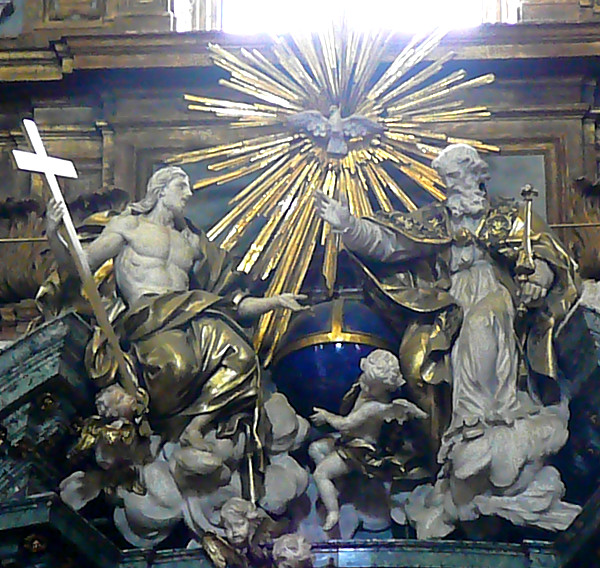
5:7 For there are three that bear record in heaven, the Father, the Word, and the Holy Ghost: and these three are one.
5:8 And there are three that bear witness in earth, the Spirit, and the water, and the blood: and these three agree in one (1 John 5:7-8 KJV).

Now verse 7 clearly speaks of what we today know as the Trinity. But when I started looking at other translations, I came across something startling. It seems as thought the KJV Bible added verse 7, that did not originally exist, into the Bible. Let us see what the other translations say.

5:7 For there are three witnesses-
5:8 the Spirit, the water, and the blood-and these three are one. (1 John 5:7-8 International Standard Version).

Here we see a huge difference. It seems as if the KJV combined verses 7 and 8 into one verse and added their own verse as verse 7 to support their own doctrine. They also added the words, “in earth” into verse 8 in the KJV to suggest that there must be three witnesses in heaven too.

Many of the translations differ from the KJV here as do the early Greek manuscripts. So where does this false doctrine originate from?

The Christian Faith is built on the writings of the early Church Fathers who created what is known as Christianity today. One of these Church Fathers is called Tertullian and he lived in 155-230 CE (AD).

Tertullian was born into a mainstream Gentile pagan family, but later he became a devout Christo-pagan. He found mainstream Christianity very intolerable, so he set out to make broad sweeping reform.

According to Jerome, Tertullian was “distressed by the envy and laxity of the clergy of the Roman church” so he joined with the Montanists (also known as the Cataphrygian Heresy) founded by Montanus. Montanus was formerly following the pagan mother goddess of fertility named Cybele where he learned plenty of things to adapt into Christianity.


One of Montanus’ “achievements” was to fall into a trance and prophecy under the influence of the “Holy Ghost,” insisting that his utterances were the voice of the “Holy Ghost.” Modern day “tongue-speaking” Pentecostal or Charismatic denominations apparently have very similar experiences to those of the church of Montanus. As Montanus’ theologies and influence advanced, he was joined by Priscilla and Maximilla, who abandoned their husbands to follow the call of his “prophetic” ministry.

Tertullian, though, while fumbling in all manner of paganism and spiritism also picked up an “anointing” of the “Holy Ghost” and through demonic inspiration, he compartmentalized the “Godhead” and coined the word “Trinity” which, of course, is one of the most cherished doctrines of the Christian Church today. The “persons of the Trinity” doctrine flourished in the hierarchy-based Christian religion, which also views itself as a pyramid structure. Tertullian wrote using puns, wit, sarcasm and a continual pounding of his opponents with invective and platitude; yet he was the architect of the pinnacle doctrine of Christianity, the “persons of the Trinity.” Tertullian theology is very akin to the likes of Nimrod, Semiramis and Tammuz who were the original trinity of Babylon and he inserted the “persons” of the Father, Son and Holy Ghost, making him extremely popular among pagan Gentile Christians.

Other trinities

Let us have a look at some Trinities found that influenced Tertullian and gave him the idea to incorporate it into the Christian religion.

Babylonian: Baal, Semiramis, Tammuz. (alt. Bel, Ishtar, Duzu).
India: Brahma, Shiva (or Devaki), Vishnu (or Krishna).
Egypt: Amon Ra, Isis, Osiris (or Horus).
Greece: Zeus (or Apollo), Demeter (or Athena, Artemis), Porsephene (or Nike).
Rome (Roma): Deus (form of Zeus, also known as Zeus-Father, or Iu-piter, Jupiter); Venus (or
Astarte, Biblia, Charis); Cupid (or Bacchus, Nike).
Celtic: (also known as Druid, Wiccan, Norse, Gaelic); Baal (or Woden, Teutates, Heil);
Ceridwen (or Freya, Frigga, Eostre); Thor (or Balder, Taranis, Dero). (alt. Esus, Taranis,
Teutates).
Canaanite: (and Phoenician); Baal (or Moloch); Asherah (or Ishtar, Easter, Tanit); Rompha.
Chaldean: (and Zoroastrian); Baal Mithras (known as “wise-lord” Ahura Mazda, or Ohrmazd);
Astoreth; Haoma.
Persian: Shamash, Ishtar, Sin. Macedonian / Asian: Dagon (fish idol); Cybele
(or Ceres); Deoius (or Janus).
Mithraic: (Chaldean fusion with Indo-Iranian); Mithras (or Marduk, called Sol by Romans);
Rashnu; Vohu Manah.
Mandaean: Joshaman, Abatar, Hibil Ziwa.
Manichaean: Ohrmazd, Maitreya (New Age “Christ”); Zurvan.

So as you can see, there is quite a list of pagan trinities and that many of them are interlinked with each other, which teaches us that the pagan religions stem from the same root. We can clearly see that the Trinity doctrine originates from paganism.

Trinity in the Scriptures?

For any kind of doctrine or teaching to be true, then that specific doctrine or teaching has to match up to every other part of the Bible. Does the Bible claim that the Messiah is also the Almighty as the Trinity doctrine teaches? Well let us look at a few verses concerning this matter.

“For there is one Elohim, and one Mediator between Elohim and men, the Man Messiah יהושע (Yehoshua)” (1 Tim 2:5)

The above verse clearly makes a differentiation between the Messiah and Elohim the Almighty. Yehoshua the Messiah is the Mediator between us and the Almighty, just like the “Kohen Gadol” (High Priest). In fact, Yehoshua is the Kohen Gadol, “Therefore, since we have a great High Priest who has passed through the heavens,
יהושע (Yehoshua) the Son of Elohim, let us hold fast our confession” (Hebrews 4:14).

The Messiah is our High Priest who is the Mediator between us and the Almighty because we are unable to come to the Almighty on our own for the forgiveness of sin. No one who is blemished is able to come into the presence of the Almighty. It is the Messiah who fulfills that roll of presenting His own blood to the Almighty for the forgiveness of our sins on Yom Kippur. If Yehoshua the Messiah was the Almighty and not a being on His own, then it would be impossible to fulfill the role of High Priest.

Let us have a look at another verse, “for us there is one Elohim, the Father, from whom all came and for whom we live, and one Master
יהושע (Yehoshua) Messiah, through whom all came and through whom we live” (1 Corinthians 8:6)

Once again we get a very clear distinction between the Almighty and His Son Yehoshua the Messiah. It states that there is only One Elohim, who is the Father, for whom we live, and only one Son who is the Messiah through whom we live. This verse also reveals to us that the Messiah has been around since the beginning. He is also know as the Living Word (Torah). That is why we are to live through Him (the Torah) in order to live for the Almighty.

So as we can see, the Bible does not support the Trinity doctrine at all, but some people take bits and pieces from the Scriptures and use it out of context to try and justify their convictions or false teachings. Let us look at one such argument that is used by the Church to try and justify their falsehood. “I and My Father are one.” (John 10:30)

Now does Yehoshua the Messiah claim the be the Almighty when He said, “I and My Father are one.”? Or was He really saying that He and His Father are in agreement with one another? To answer this question, we need to compare it with the rest of what is written in the Bible. “And I am no more in the world, but these are in the world, and I come to You. Set-apart Father, guard them in Your Name which You have given Me, so that they might be one, as We are” (John 17:11)

The above verse is speaking of the followers of the Almighty to become one as the Almighty and the Messiah are One. Now, can a group of people suddenly become one person? Or is this verse speaking of a group of people standing in agreement with each other and in agreement to the Almighty and His Messiah? Now let us look at another verse and see if this statement is consistent, “so that they all might be one, as You, Father, are in Me, and I in You, so that they too might be one in Us, so that the world might believe that You have sent Me” (John 17:21).

Once again it clearly says that the people stand together in agreement with each other and in agreement with the Almighty and Yehoshua the Messiah. It does not mean that they are one person at all. The Hebrew idiom “being one” means to be in agreement with each other. This terminology comes from the very beginning of the Scriptures, “For this cause a man shall leave his father and mother, and cleave to his wife, and they shall become one flesh” (Gen 2:24).

Now I ask you, how many of you have ever witnessed a man and his wife physically joining and becoming one person? No one has ever seen this happen because that is not what is meant by becoming one flesh. It simply means to join together in agreement with each other.

So any one who uses the argument that the Messiah said, “I and My Father are one” to prove the Trinity doctrine, is either not very well versed in the Bible or is simply a liar.

One very important message for us all is that it is saying that the Almighty and His Messiah (the Living Word) call us to become one with them. Now we also know that The Almighty and His Word (the Messiah) are never changing and remains the same today as in the time of the beginning, ”
יהושע (Yehoshua) Messiah is the same yesterday, and today, and forever” (Heb 13:8).

We have also seen from above that the Messiah was there from the beginning in the time of Adam. We can also see that He is the same today as He was in the beginning, and He is in perfect agreement with His Father who is the Almighty Master of the universe.

So if we want to learn how to serve the Almighty and follow the Messiah, then we have to go to the Instruction book called the Torah, which are the first five books of the Scriptures (Tanakh). In those five books, the Almighty reveals to us what He requires from us and also the things that He loves and also the things that He hates.

Those five books give us exact instructions on how to live our lives to be pleasing to the Almighty in order to receive favor from Him.

There are many things that the Almighty regards as abominations and teaches us to NOT do them or have them close to us. These things, for example, are eating unclean animals, making moulded images (like the cross) adultery, idolatry, profaning the Sabbath, Murder, Rape and many other things too. Now to think that what was once unacceptable to the Almighty has suddenly become okay to do today is a teaching that is anti-Scriptural and evil.

If we desire to love the Almighty, then we need to do all that is commanded in the Torah.
“If you love Me, you shall guard My commands” (John 14:15)

Also.... click here to see John 1:1-3 explained